Key takeaways:
- This distinction matters because burden-shifting implies withdrawal, while responsibility-sharing implies empowerment and inclusion.
- In effect, he challenged Seoul to embrace a self-conception aligned with its actual capabilities, that of a global actor critical to shaping Indo-Pacific stability, not merely a frontline state facing North Korea.
- By demanding more of Seoul and, in turn, granting it greater agency, he helped catalyze the transformation of the U.S.–ROK alliance from a mentorship into a mutual enterprise, from reliance to alliance.
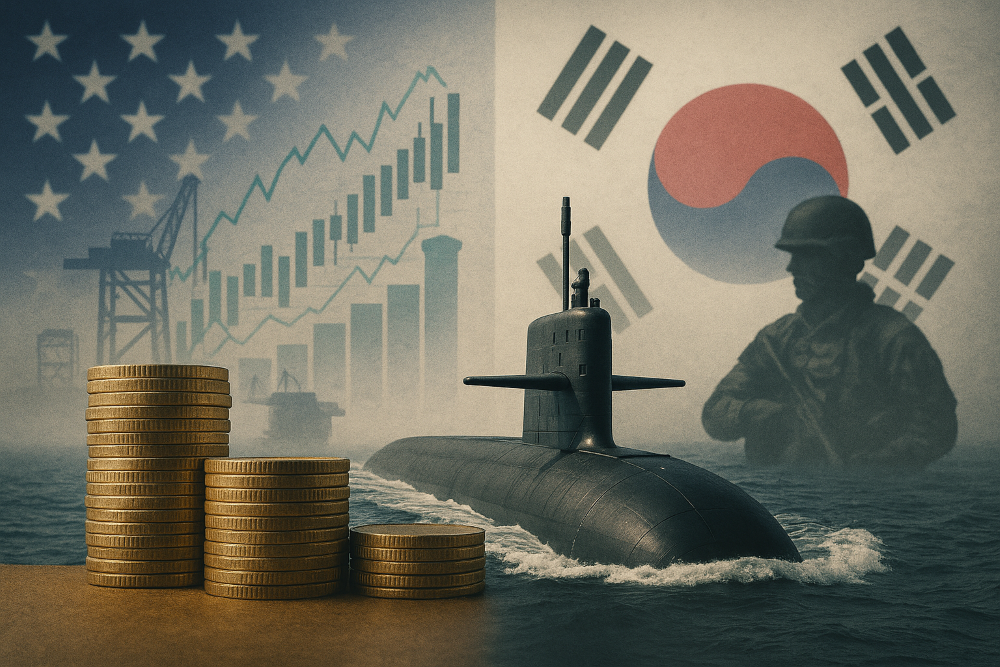
Since the early months of his presidency, President Donald J. Trump’s approach to America’s alliances has been both disruptive and revelatory. For South Korea, one of Washington’s most steadfast defense partners in Asia, his method was particularly transformative. At first glance, President Trump’s insistence that U.S. allies increase their defense contributions seemed to signal a transactional mindset that risked unsettling long-established bonds. Yet beneath that rhetoric lay something more consequential, a reframing of the U.S.–Republic of Korea (ROK) relationship not as patron to client, but as a partnership between equals tasked with jointly defending and advancing shared strategic interests in the Indo-Pacific. His message to Seoul was clear, the time had come for South Korea to step fully into its role as a capable, self-confident regional power, not simply as a beneficiary of U.S. protection. Far from abandoning the alliance, this approach sought to mature it and transform an asymmetrical relationship rooted in the Cold War into a modern strategic compact befitting a South Korea that had emerged among the world’s foremost economies, democracies, and security contributors.
President Trump’s entrance forced these issues into the open because his direct questioning of alliance costs and responsibilities unsettled policymakers on both sides. Critics often described his push for higher South Korean defense spending and cost-sharing as crude burden-shifting that reduced the alliance to a transactional ledger. But this reading overlooks the continuity between his rhetoric and a deeper tradition of strategic recalibration that expects capable allies to share not just fiscal, but also strategic responsibility for collective defense. At times inelegantly, President Trump articulated an expectation that America’s wealthiest and most capable partners should carry a larger share of the load in defending the free world, rather than relying indefinitely on U.S. subsidies.
This distinction matters because burden-shifting implies withdrawal, while responsibility-sharing implies empowerment and inclusion. President Trump sought to make clear that the United States, while remaining the bedrock of regional security, would not forever subsidize an order in which others underinvest in their own defense. South Korea, endowed with advanced capabilities and national resilience, was precisely the kind of ally Washington wanted to see take on greater leadership. Under his administration, negotiations over the Special Measures Agreement on host-nation support for U.S. forces were contentious but clarifying, as Washington pressed for steep increases and Seoul maneuvered to frame any rise in its contribution as part of a more strategic, long-term alliance modernization. Seoul’s willingness to increase its contributions, while simultaneously expanding coordination on missile defense, intelligence-sharing, and joint exercises, demonstrated that shared responsibility could strengthen rather than strain the alliance.
Behind President Trump’s demands lay an implicit invitation to equality. He signaled that Seoul’s growing strength and global stature were not inconvenient realities to be managed, but welcome assets to be fully integrated into a shared strategy. By insisting on more equitable participation, President Trump upended the traditional U.S.–ROK dynamic in which reassurance flowed one way, from Washington to Seoul, and dependency shaped expectations on both sides. His language often suggested impatience, but his strategic instinct reflected a belief in South Korea’s potential to act as an equal partner rather than as a perpetual security dependent. In effect, he challenged Seoul to embrace a self-conception aligned with its actual capabilities, that of a global actor critical to shaping Indo-Pacific stability, not merely a frontline state facing North Korea.
Rather than undermining deterrence, this recalibration strengthened it. A South Korea increasingly confident in its own defense capabilities enhances, rather than diminishes, the credibility of U.S. commitments by signaling that any aggression would face not only U.S. power, but a capable and determined local ally. Deterrence in the Indo-Pacific now depends not solely on American military might, but on a constellation of capable partners willing to act in concert to resist coercion and revisionism. President Trump’s approach anticipated this architecture, even as many observers focused primarily on his rhetoric and style. In this context, “equal partnership” in security terms is not a euphemism for U.S. withdrawal, but a pathway to more durable stability rooted in shared will and distributed capabilities.
In the broader Indo-Pacific competition, the U.S.–South Korea alliance has implications far beyond the Korean Peninsula. President Trump’s emphasis on equality resonated with his administration’s goal of building a network of self-reliant partners capable of collectively deterring coercion by major powers. By viewing South Korea as a co-equal stakeholder, Washington effectively widened the scope of Seoul’s expected engagement, from a narrow focus on North Korea to a broader role in regional security, maritime domain awareness, and supply-chain resilience. The administration encouraged South Korea to find greater synergies with like-minded democracies such as Japan, Australia, and India, reflecting an understanding that Indo-Pacific resilience would depend as much on allied initiative as on American leadership.
President Trump’s re-envisioning of equality extended beyond defense into economic and technological domains that shape long-term strategic outcomes. In trade, he pressed for recalibration of KORUS that recognized South Korea’s advanced, globally competitive economy as a peer, not a dependent market, while continuing to support robust bilateral commerce. In technology, the administration promoted cooperation with allies on critical sectors such as 5G, semiconductors, and digital infrastructure to reduce reliance on Chinese supply chains and standards. This approach implicitly cast South Korea, home to world-leading chip and electronics firms, as a technological partner of first order, whose choices would significantly influence the balance of economic security in the region.
No dimension of President Trump’s engagement tested the alliance more visibly than his first-term diplomacy with North Korea. The high-profile summits in Singapore and Hanoi triggered anxiety in Seoul, where policymakers feared marginalization or abrupt shifts in U.S. posture. Yet his direct engagement with Pyongyang, however unconventional, also highlighted that peace and stability on the peninsula were joint challenges requiring close U.S.–ROK coordination. His administration expected Seoul not to remain a passive observer, but to participate actively in post-summit diplomacy and contingency planning, reinforcing the idea of co-ownership of the peninsula’s future. The experience of navigating the uncertainties of U.S.–North Korea diplomacy pushed South Korea to strengthen its own diplomatic capacity, inter-Korean initiatives, and regional outreach.
Alliance management is as much psychological as it is strategic, and the U.S.–ROK partnership has long been shaped by narratives of protection, vulnerability, and dependency. President Trump disrupted those narratives with a message that to many Koreans sounded provocative but also validating, South Korea is strong enough to do more and should act accordingly. To some, this seemed dismissive of past sacrifices; to others, it was a long-overdue acknowledgment of the country’s transformation into a confident middle power. Over time, this shift carries potential long-term benefits because equal partners tend to make clearer decisions, share risks more fairly, and build deeper trust. As the emotional premise of the alliance evolves from gratitude to solidarity, the relationship becomes better positioned to weather tactical disagreements while preserving strategic alignment.
Policy analysts often measure alliance health in budgets, bases, and formal agreements, but beneath those metrics lies a deeper element, tone. President Trump’s unapologetically assertive tone changed how both nations spoke about their partnership, moving the discourse from deference to dialogue. High-level interactions increasingly encompassed not only defense coordination, but also cooperation on broader issues such as regional economic security, pandemic response, and supply-chain restructuring, even if those agendas were more fully articulated after his term. The relationship thus became more multidimensional, capable of friction, yet resilient because it rested on shared interests and values rather than one-sided dependence.
History will continue to debate the style and substance of President Trump’s diplomacy, but the structural impact of his approach toward South Korea is likely to endure. By demanding more of Seoul and, in turn, granting it greater agency, he helped catalyze the transformation of the U.S.–ROK alliance from a mentorship into a mutual enterprise, from reliance to alliance. The result is a partnership better suited to confront the strategic realities of the 21st century, North Korea’s evolving threat, China’s regional assertiveness, and global challenges that no single nation can manage alone. Far from diminishing American leadership, this model amplifies it through empowered allies whose strength contributes directly to a more stable order. A South Korea that stands shoulder to shoulder with the United States strengthens not only deterrence on the Korean Peninsula, but also the resilience of the entire Indo-Pacific architecture. President Trump’s conviction that strong allies make strong alliances helped recast a foundational relationship for a new era, opening the door to a U.S.–ROK partnership defined by mutual commitment and co-equal strategic stakes rather than by the asymmetries of the past.
Eli M. Gold, an accomplished leader and strategist, has dedicated his career to shaping international policy, fostering bipartisan collaboration, and advancing strategic solutions to complex global challenges. As the President of the Gold Institute for International Strategy in Washington, D.C., since May 2019, Eli has spearheaded the creation of a dynamic policy organization focused on delivering practical insights and effective solutions to pressing global issues. Under his leadership, the Institute has convened a bipartisan international working group comprising former members of congress, parliamentarians, diplomats, and military leaders from 10 countries to address the future of alliance strategy. Eli provides invaluable policy guidance to lawmakers in the U.S. and abroad, while also mentoring and directing the Institute’s 35 fellows and staff. Prior to his role at the Gold Institute, Eli co-founded and served as Senior Vice-President of The London Center for Policy Research in New York, NY/Washington, D.C. His visionary leadership was instrumental in assembling a team of senior policy experts spanning the military, intelligence, and diplomatic communities to tackle critical foreign policy and national security challenges. Eli’s bipartisan coalition of congressional members facilitated in-depth studies on national security and foreign policy matters, while his engagement with foreign ambassadors, parliamentarians, and military leaders fostered dialogue and provided guidance on global issues. He also played a pivotal role in establishing the TransAtlantic Dialogue, facilitating candid discussions on security concerns between members of Congress and European parliamentarians. Eli’s commitment to public service and advocacy extends beyond international affairs. As the Founding Chairman of The Harbour League in Baltimore, MD, he pioneered efforts to promote free-market and conservative ideas, addressing public policy concerns in Maryland. Through his leadership, The Harbour League evolved into a unique state-based think tank, offering research-driven recommendations on key local issues and attracting renowned speakers and public figures. Earlier in his career, Eli held leadership roles at the Insurance Group of America and The MONY Group, where he developed innovative marketing strategies and insurance programs, and cultivated strong client relationships. Throughout his career, Eli has been a sought-after media commentator, contributing his expertise to national, international, and local TV, radio, and print media outlets. His passion for effective policy solutions and his ability to foster collaboration across sectors make him a respected leader in the field of international relations and public policy.