- #Energy & Climate
- #Global Issues
Key Takeaways:
- Treaty Suspension as a Turning Point: India’s suspension of the Indus Water Treaty (IWT) following a terrorist attack highlights how water, while rarely a direct cause of war, acts as a "threat multiplier" in politically fragile regions. The move underscores the treaty's vulnerability to broader geopolitical tensions.
- An Obsolete Framework: The 1960 agreement is increasingly viewed as outdated, as it lacks mechanisms to address modern challenges like climate change, severe flooding, and groundwater depletion. Its rigid division of rivers prevents the holistic, ecological management needed for the region's changing environment.
- Opportunity for Modernization: Rather than signaling inevitable conflict, the suspension offers a strategic opening to renegotiate a "future-ready" treaty. A new agreement could prioritize climate data sharing and ecological preservation, securing the basin for millions of dependents while preventing water from being weaponized in future disputes.
Water and Conflict in the Indus Water Basin
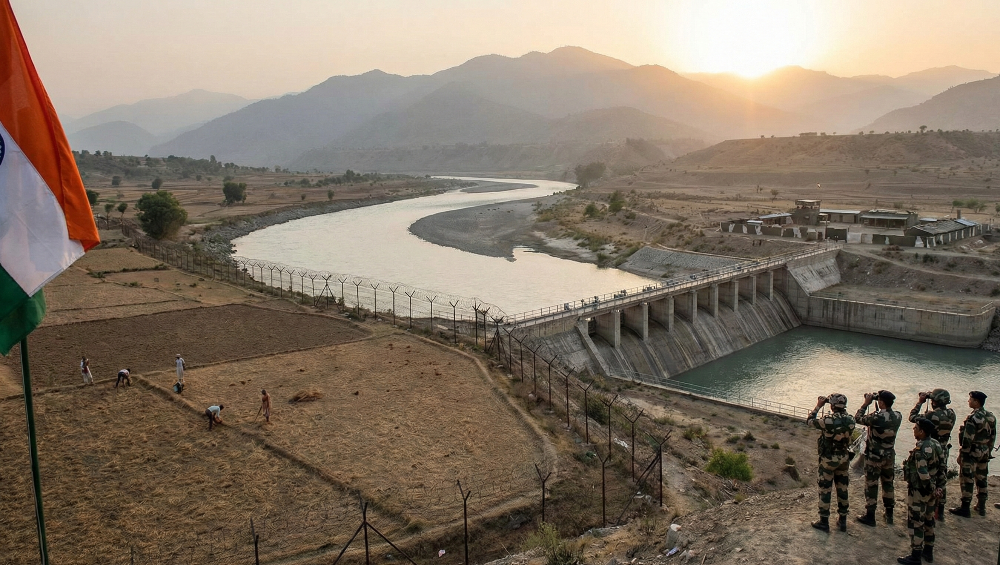
India’s suspension of the Indus Water
Treaty with Pakistan, following a deadly terrorist attack against tourists in
Kashmir in April 2025, has fueled an interesting and important debate on the
relationship between water security and conflict. Not a new debate necessarily,
but one that is especially vital in the context of South Asia; a region that
holds some of the most populous countries, is one of the least integrated, has
high instances of risks from climate change and numerous hotspots of tension.
The suspension of the Indus Water Treaty (IWT) underscores the fragility of
relationships, and also prompts a more critical understanding of the treaty
itself - the need to renegotiate and upgrade a document that does not reflect
the realities of the present. It also underlines how fragile water systems can
be when embroiled in political conflicts. Water scarcity and/or mismanagement
might not represent a genuine casus belli, but often exacerbates
existing tensions and becomes a tool in larger conflicts.
Globally water has rarely been the direct
cause of war but it has become embroiled in other forms of conflict and has
often been used as a weapon and/or tool by both state and non-state actors. There
are a total 263 international and transboundary rivers that constitute approximately
60% of the global freshwater, where close to half of these have a potential for
regional or international conflict. And while there have been more instances of
cooperation over shared waters than conflict since the two world wars, this is
changing. Research indicates that in 2024 there were 420
instances of violent events over water, from targeting people in rural
areas, to attacks on canals and dams, to cyber breaches of utilities and grids.
There has been a steady rise over the last few years, with the highest cases of
being water as a casualty
in another form of conflict.
A multi-dimensional issue, conflict can
arise as a result of a number of historical, political or socio-economic
drivers and increasingly due to resource constraints and environmental drivers.
The correlation between water and conflict can be perceived in two overarching ways
– where the degradation of the resource can lead to a reduction in security or
where a prevailing instance of conflict can harm the resource further
compromising non-traditional aspects of security such as food or health. In
both cases poor management and lack of cooperation between states within an
accepted legal framework can increase vulnerability and risk; extremely
heightened in the case of South Asia.
Signed in 1960, the IWT between India and
Pakistan, brokered by the World Bank, has withstood war and cross border
conflict between the two countries, and often been hailed as a success story in
the larger global discourse on transboundary water. While in prevailing
international relations, the IWT and 65 years of functional cooperation is
considered a success, the treaty has been subject to political securitization. After
months of negotiation, the governments on both sides agreed to split the 6 main
rivers of the basin, with the three western rivers to be used and governed by
Pakistan and three eastern rivers to be used by India, with some caveats in
place. Certain restrictions were placed on India as the upper riparian,
especially on storage, and use of water for irrigation, electricity generation and
other activities. While no war has directly been fought between the two
countries on water, there have been over the years instances of small scale
tensions over water and more recently incendiary remarks by government
officials on both sides of the border with respect to the river basin. After
placing the treaty into abeyance, the Indian government has officially declared
that it will never
be restored.
From an environmental and ecological
perspective, a necessary lens in a region that is constantly subject to the
uncertainties and cascading risks of climate change, the treaty can be
considered an obstacle to robust transboundary water management. The effects of
a warming climate are being acutely felt in the region, from increasing high
temperatures and heat waves to devastating floods, the likes of which Pakistan
witnessed in 2022 that affected over 30 million people. There is also a record
high groundwater depletion leading to a food and health crisis. A severe water
crisis compounded with other effects of climate change coupled with population
growth and increasing demand will further strain relations on the shared river
basin. Very little of this is reflected in the treaty that has not been
upgraded or amended to deal with present and future crises.
The paucity of communication and
cooperation could lead to further tension between the two countries, propelled
by attacks by terrorist groups and other non-state actors. While the countries
are unlikely to go to a full scale war over water, the lack of an open channel
of communication on the Indus could be used as a control factor or as a means
to ignite hostilities.
The future of the Indus
The prevailing discourse has veered towards
the assumption that the suspension of the Indus Treaty by India signifies the
end of all negotiations over the river basin; and that war could be fought in
the region by a combination of actors over water. In the broader South Asian
context, there is also growing uncertainty regarding other water agreements and
treaties, some of which are due for renewal. These include the Mahakali Treaty
between India and Nepal that has been over-due for renewal since 2017 and the
Ganga Agreement between India and Bangladesh due for renegotiations in 2026
(discussions on this have already begun). In a region that already ranks
extremely low on regional cooperation on water and climate, a further breakdown
of existing agreements and treaties could prove detrimental. There is also the
looming shadow of China’s increased dam building activity on the Yarlung
Tsangpo that flows into India as the Brahmaputra River.
With a number of existing fault lines in
the region it is easy to assume that water will spark war in South Asia. This
thinking reduces a complex region to a simple narrative that can prevent a more
concerted effort, in stages, towards joint water management. It is also
important to note that the suspension of the IWT does not signify its end, but an
opportunity to renegotiate a treaty that does little to aid the development of
communities dependant on the rivers or the long term preservation of the
ecology and environment of the river itself. There have been several requests
for renegotiation from India that have been rejected by Pakistan and any
positive movement on starting a talks for talks on the river basin could prove
beneficial. These could be relooking at certain aspects of data sharing,
project-specific design audits, benchmarks and criteria for negotiations on
development projects or the addition of climate related data that is currently
missing.
It is important to understand where the
opportunities may lie and recognise that the previous IWT had several glaring
gaps that do not reflect present realities or the risks arising from climate
change. It is equally vital to acknowledge that keeping a channel of
communication open on shared water helps safeguard them from being used as a
weapon or tool on other forms of conflict. From a hydro-ecological perspective,
the IWT might not have done much to serve the river basin, it did offer a
shield away from the risk of military escalation arising out of water that
would be perilous for the 300 odd million directly and indirectly dependant on
the basin. Urgent efforts are required to reduce the risk of water related
conflict and to ensure that water does not embroiled in other sources of
tension. By fronting the UN SDGs on water and sanitation both India and
Pakistan can work towards negotiating and upgrading aspects of the existing
treaty to one that is future ready and write a new success story for a renewed Indus
Water Treaty and river basin.
Ambika Vishwanath is a geopolitical consultant and global strategy adviser with a special focus on the nexus between foreign policy, water security, and diplomacy. She is a nonresident fellow with the Agora Strategy Institute in Germany.