- #China
Key takeaways:
- They have also highlighted that Russia has served as the BRICS chair and China as the SCO chair, agreeing to deepen cooperation to oppose U.S. and Western hegemonism and to elevate the bilateral relationship beyond Cold War-era ideological alignment to a higher-level strategic partnership.
- Aligning SCO cooperation with China’s multipolar-order agenda, Beijing offered 20 billion yuan in grants and an additional 10 billion yuan in loans via key member-state banks, and proposed establishing an SCO Development Bank following the BRICS New Development Bank (NDB).
- Overall, the post-SCO landscape has sharpened bloc dynamics between the West and an emerging counter-Western coalition, and the international system is entering a new era of competition for order-setting leadership in the post-Cold War period
Despite the protracted Russia–Ukraine war and the intensifying U.S.–China strategic competition, the China–Russia Joint Statement issued in Moscow on May 8, 2025, is widely assessed as consolidating the two countries’ determination to advance a new multipolar international order. In particular, following the rise of the Global South amid the prolonged Russia–Ukraine war and heightened U.S.–China rivalry, a BRICS- and Eurasia-centered multipolar order led by China and Russia has been emerging as an alternative to the U.S.-led rules-based international order. China and Russia increasingly view the advent of a multipolar order as an irreversible historical trend, and they are seeking to reshape the international order through closer solidarity and cooperation among Global South countries—a development that poses a significant strategic challenge for the Republic of Korea.
Over the past three years of the Russia–Ukraine war, China–Russia relations have become a highly consolidated partnership from which neither side can readily disengage. Through multiple summits, Beijing and Moscow have reiterated their clear opposition to NATO’s eastward expansion and to U.S.-led initiatives such as the Indo-Pacific strategy and the trilateral U.S.–ROK–Japan framework, while underscoring the importance and necessity of their strategic cooperation. They have also begun to emphasize the need to build a new multipolar order by highlighting the rapid decline in the standing of the U.S.- and Western-led international order—pointing to domestic political polarization in the United States as well as the perceived shortcomings of Western financial capitalism, including widening inequality. After the prolonged war and intensified U.S.–China strategic competition, the Xi Jinping leadership has explicitly framed the current era as a “once-in-a-century transformation” in the international order and has articulated a medium- to long-term plan to expand political, economic, and security cooperation comprehensively with Russia, BRICS, the Shanghai Cooperation Organization (SCO), and Global South countries as key pillars of a multipolar order.
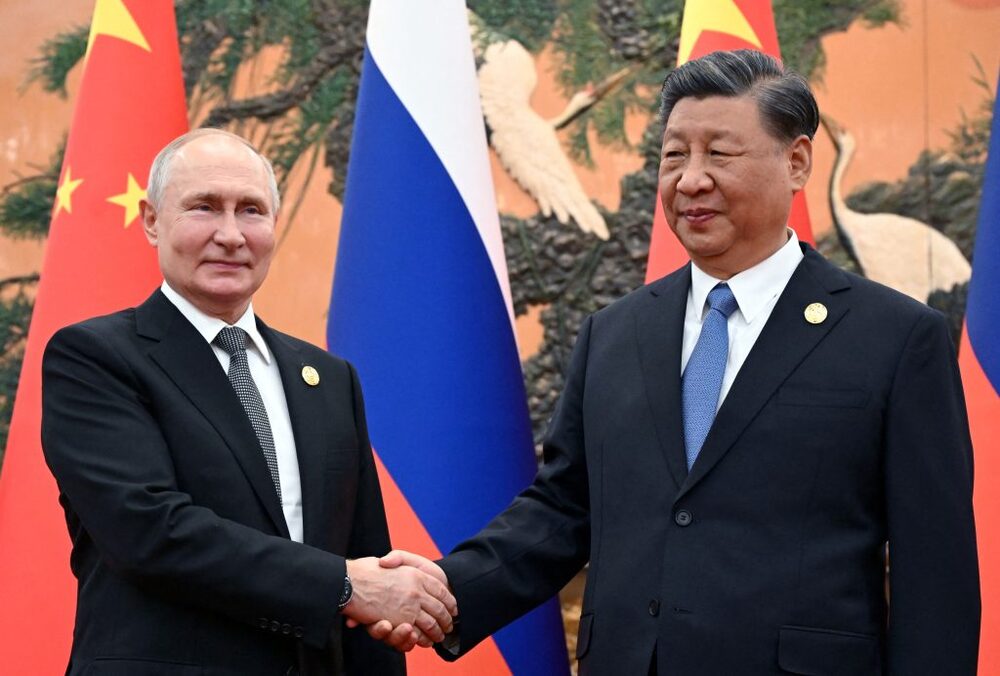
The China–Russia strategic partnership has continued to solidify, with President Xi Jinping and President Vladimir Putin both attending the 80th anniversary events commemorating the victory in the Great Patriotic War and the anti-fascist war in Moscow on May 9, 2025, as well as the 80th anniversary commemorations of victory in the War of Resistance Against Japanese Aggression in Beijing on September 3, 2025—high-profile displays of political closeness. In December 2024, Deputy Chairman of Russia’s Security Council Dmitry Medvedev made an official visit to China and met President Xi; the two sides agreed to further strengthen strategic cooperation and internal drivers of cooperation at the United Nations, BRICS, and the SCO in order to build a new type of major-country relationship.
Some analysts argue that building more cooperative relations with Western countries is necessary to end the Russia–Ukraine war swiftly. However, in the aftermath of the war, China and Russia have undertaken a fundamental reassessment of the United States and the West, citing concerns about excessive pursuit of hegemonic interests. Moving beyond a previously cautious posture, China—now the world’s largest manufacturing power has sought very close strategic coordination with Russia to advance the Belt and Road Initiative (BRI), secure stable access to energy and resources, and expand markets for industrial goods and consumer products. To promote a BRICS and Eurasia-centered multipolar order, the two sides have been operationalizing five consistent principles through joint declarations: (1) sustained emphasis on strategic communication and coordination at the leaders’ level; (2) adherence to the principles of non-alliance, non-confrontation, and democratic equality; (3) strengthening the role of UN Security Council permanent members and maintaining balance and “right conduct” in the international order; (4) pursuing universal benefits and mutual win–win outcomes; and (5) advancing a democratic and equitable multipolar international order. They have also highlighted that Russia has served as the BRICS chair and China as the SCO chair, agreeing to deepen cooperation to oppose U.S. and Western hegemonism and to elevate the bilateral relationship beyond Cold War-era ideological alignment to a higher-level strategic partnership.
Against this backdrop, the 25th SCO Summit held in Tianjin, China, from August 31 to September 1, 2025, was the fifth summit hosted by China and the largest in the organization’s history, attended by leaders or heads of government from roughly 20 countries and representatives of 10 international organizations. In his public address, President Xi Jinping declared the goal of establishing a “more equal and fair multipolar international order” and called for accelerated security and economic cooperation among member states. Aligning SCO cooperation with China’s multipolar-order agenda, Beijing offered 20 billion yuan in grants and an additional 10 billion yuan in loans via key member-state banks, and proposed establishing an SCO Development Bank following the BRICS New Development Bank (NDB). China also criticized certain Western countries for undermining free trade through discriminatory sanctions and coercive “bullying” measures, signaling that it would respond through closer solidarity with Russia, BRICS, and SCO member states.
The summit, expanded under an “SCO Plus” format, brought together leaders from approximately 21 countries. In his keynote speech, President Xi criticized Cold War thinking, hegemonism, and protectionism, arguing for an overhaul of the international order that is just and reasonable and for collective responses to new threats and challenges. The summit adopted the Tianjin Declaration, which criticized manifestations of hegemonism, called for joint responses to ethnic separatism, religious extremism, and international terrorism, and opposed Cold War mentality, hegemonism, and protectionism. Notably, unlike the Qingdao Declaration adopted at the 2018 SCO Summit—which included support for China–Russia peace initiatives aimed at promoting denuclearization of the Korean Peninsula and safeguarding durable regional peace and stability—the Tianjin Declaration did not contain direct references to North Korea’s nuclear issue. The declaration also underscored the limitations of the U.S.- and Western-centered order and the need to reform global governance, referencing issues such as calls to halt Israel’s and the United States’ strikes against Iran and to end the mass killings in Gaza, as well as opposition to Western unilateral sanctions. China further presented a medium- to long-term agenda to broaden cooperation, including opening its ultra-large domestic market, developing solar and wind power projects, establishing an AI cooperation center, sharing the BeiDou satellite navigation system, and expanding collaboration in advanced technology domains such as space and lunar exploration.
Following the summit, China compiled member states’ priorities and released an SCO “Next Decade (2026–2035) Development Plan.” Key elements include establishing an SCO Development Bank; providing 20 billion yuan in grants (2025–2028); extending an additional 10 billion yuan in loans (2025–2028); expanding scholarships for member states and introducing new master’s and doctoral programs; setting up around 10 Luban Workshops (vocational skills training centers); and offering roughly 10,000 vocational training opportunities. Foreign Minister Wang Yi praised the plan as a significant milestone, indicating that China would support implementation in a friendly and proactive manner. China reiterated its goal of accelerating multipolarity by 2035, opposing Western “hegemonic” practices such as unilateral tariff measures that undermine WTO rules, interference in sovereignty, and coercive “bullying” actions, while emphasizing the need to build a fair and equal multipolar order. The Tianjin joint declaration strongly supported the WTO-centered multilateral trading system and signaled opposition to retaliatory measures that violate WTO rules, including large-scale unilateral tariffs such as those associated with President Donald Trump.
The record-scale SCO Summit can be viewed as a symbolic event heralding a new phase of international order formation. China and Russia argue that structural changes to the U.S.- and Western-centered order have become inevitable after the Russia–Ukraine war, framing the current period as a “once-in-a-century transformation.” Under the Belt and Road Initiative (BRI) and the vision of a “community with a shared future for mankind,” China has advanced the Global Development Initiative (GDI), the Global Security Initiative (GSI), and the Global Civilization Initiative (GCI), and has further proposed a Global Governance Initiative (GGI), calling for a fair and equal multipolar international order. While the United States and other Western countries express resistance and concern regarding the China–Russia-led multipolar project, many Global South states have shown willingness to participate, suggesting that the United States and the West also need more attractive and cooperative policy alternatives than in the past.
Overall, the post-SCO landscape has sharpened bloc dynamics between the West and an emerging counter-Western coalition, and the international system is entering a new era of competition for order-setting leadership in the post-Cold War period—amid the prolonged Russia–Ukraine war, U.S.–China strategic competition, instability in the Taiwan Strait, strengthened ROK–U.S. and ROK–U.S.–Japan security cooperation, and closer China–Russia–North Korea coordination. Going forward, the Republic of Korea should seek a national-interest-centered pragmatic diplomacy that, while sustaining the ROK–U.S. alliance, also builds balanced and constructive relations with neighboring China and Russia, and should advance more active efforts and policy options to preserve regional peace and stability under the altered realities of the international order.
Jae-Hung CHUNG is Senior Fellow at the Sejong Institute(2015-present). He received B.A. M.A from Peking University in China (Beijing) and Ph.D. from Chinese Academy of Social Science in China (Beijing). He was an Assistant professor of Kyungnam University (2013-2015), the Institute of Far Eastern Studies (IFES) Analysis (2007-2013) and policy advisor Ministry of National Defense, Foreign Affairs and NIS. . China University of Political Science and Law(Beijing), China Association for International Friendly Contact(CAIFC)(Beijing),The Shanghai Institutes for International Studies (SIIS)(Shanghai), Valdai Discussion Club and HSE(Higher School of Economics)(Moscow) Visiting scholar. He has served as Consulate General of the Republic of Korea Guangzhou in China, Senior Political Researcher (2010-2012). Main research interests include Chinese Security (Defense) and Foreign policy, Sino-Russian Relations, Eurasian Regional Economic and Security Issues, Cooperation through BRICS and SCO. Recently his research paper and writings include The recent U.S.-China military security competition and the Taiwan Strait crisis (2021), Strategic Competitions among Russia, China and the US: War in Ukraine(2022), China-Russia Strategic Security-Economic Partnership and Expansion of the Shanghai Cooperation Organization (SCO) after the Ukraine Crisis(2023), Changing Global multipolar Order: China’s Influence and Strategy(2024) and so on.