- #Economy & Trade

- The Supreme Court’s decision striking down the administration’s use of IEEPA tariffs has not resolved uncertainty in U.S. trade policy but instead introduced new legal and political complexities.
- Although the ruling reaffirms congressional authority over tariffs, the administration retains alternative legal tools, contributing to continued unpredictability in trade measures and economic planning.
- In response, South Korea faces sustained volatility in its trade environment and must balance short-term engagement with Washington with longer-term economic stabilization and diversification efforts.
The latest Supreme Court (SCOTUS) decision
striking down President Trump's use of the International Emergency Economic
Powers Act (IEEPA) to impose tariffs was widely anticipated
— but its consequences for U.S. trade partners like South Korea are
anything but settled. Rather than resolving the questions that has defined U.S.
trade policy in recent months, the ruling has opened a new chapter of uncertainty
that Seoul will have to navigate carefully.
What Comes Next in the U.S.?
The Trump administration wasted no time
signaling its intentions. Immediately following the ruling, the White House announced
it would invoke Section 122 of the Trade Act of 1974 to impose a 10% global
tariff for 150 days; President Trump subsequently declared
shortly thereafter that he will raise that figure to 15%. To date, the only
legal action taken was to impose the global tariff at 10% - for now. Legal
experts question
whether Section 122 is even legal, since its use requires a balance of
payments crisis that does not currently exist.
Even so, the administration has other tools
at its disposal. Section 338 of the Tariff Act of 1930 allows tariffs if other
countries "uniquely discriminate" against the United States. Sections
232 and 301 — covering national security and unfair trade practices
respectively — remain on the table as well, though both require investigative
reviews that take time. Meanwhile, over 3,000 lawsuits related to the
now-invalidated IEEPA tariffs are working their way through the courts, with
more than $175
billion in collected tariff revenue potentially subject to refund. The road
ahead is legally and politically messy.
Crucially, the Court's majority ruling included
"the major questions doctrine" warning that Congress should not
be assumed to have relinquished its constitutional tariff authority, found
explicitly in Article I, Section 8, through vague statutory language. This
signals that future unilateral tariff actions by the executive branch will face
legal scrutiny, adding yet another layer of uncertainty to an already volatile
environment.
A Fragile Deal Under Pressure
For South Korea, the stakes of the SCOTUS ruling
are particularly high. Even before the Court issued its decision, relations
with Washington had grown tense: President Trump had publicly
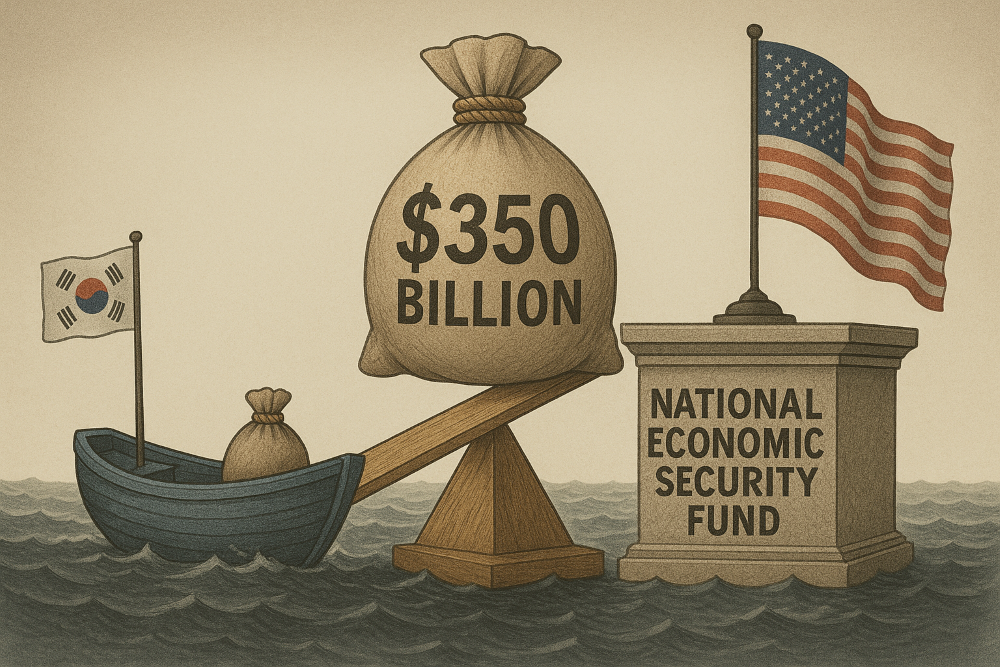
accused Seoul of deliberately stalling on its first $20 billion investment
tranche — part of a broader $350 billion commitment South Korea made in
exchange for a reduced IEEPA tariff rate of 15% instead of 25% — while the U.S.
Trade Representative had briefly floated the possibility of reverting to the
original 25% rate. That November 2025 agreement, itself the product of months
of difficult negotiations beginning with President Lee Jae Myung's first
Washington summit in July and only formally announced at the APEC Summit in
October. It now rests on uncertain legal ground since the tariff relief it was
premised on has been struck down. Despite all of this, the South Korean
Ministry of Industry, Trade, and Resources (MOTIR) decided to maintain the
terms of the November agreement — a pragmatic choice, given that the
administration still holds leverage through existing Section 232 tariffs on
automobiles and steel, and could impose new ones on pharmaceuticals or
semiconductors.
The Paradox of Certainty: Why the Ruling
May Make Trump More Unpredictable
On the surface, the SCOTUS ruling appears
to impose a measure of order on U.S. trade policy. By reaffirming that Congress
— not the president — holds primary authority over tariffs under Article I,
Section 8, and signaling that future unilateral executive action will face
serious legal scrutiny, the thinking may be that the decision places limits on the
administration’s ambitions. Some governments, most notably China,
may read this as the imposition of meaningful guardrails. If courts can strike
down IEEPA tariffs, the reasoning goes, Trump’s leverage is more limited than
it appeared, and negotiations can proceed on firmer ground.
Paradoxically, it is precisely this
impression of constraint that makes the administration’s behavior more
unpredictable. The reason is straightforward: revenue. The IEEPA tariffs
generated over $175 billion for the federal government over roughly a year of
collection. That revenue is now at legal risk, with thousands of refund
lawsuits working their way through the courts. It is important to recognize
that the administration did not build its tariff strategy around legal grounds;
it built it around leverage and revenue. Losing the legal basis for that
revenue stream does not make it walk away from tariffs — it will scramble
harder to find replacements.
This scramble is itself the engine of
volatility. Each time the administration reaches for a new legal instrument —
Section 122 one day, Section 338 the next, with the threat of Section 232 or Section
301 always in the background — it introduces a fresh round of uncertainty for
businesses and foreign governments trying to plan around U.S. trade policy.
Unlike the IEEPA tariff, which was sweeping but at least singular and legible, the
patchwork of sectoral and contingent measures are harder to anticipate and
price in. Countries that believe the SCOTUS ruling has clipped the
administration’s wings may find themselves caught off guard by measures they
did not see coming.
For South Korea, this realization matters.
The volatility already visible in its 2025 trade data is not simply a byproduct
of high tariffs; it reflects the difficulty of operating in an environment
where the rules of engagement shift faster than businesses can adapt. A single
large tariff, however painful, can eventually be priced in. A constant adjustment
of which legal authority will be invoked next, targeting which sector, under
which set of political conditions, will be costly and time consuming. If other
governments feel comfortable about the SCOTUS ruling and ease their vigilance,
Seoul should resist that temptation. The ruling changed the legal vehicle; it
did not change the destination.
The Trade Data Tells the Story
South Korea's 2025 trade figures reflect
the turbulence. Total goods trade with the United States fell marginally from
roughly $200 billion in 2024 to $196 billion in 2025, with exports declining
from $128 billion to $122.9 billion — the first such decrease since 2016. The
trade surplus with the U.S. shrank by over 11%, dropping from $55.6 billion to
$49.5 billion.
The monthly data also shows that automotive
exports (South Korea's largest goods export category to the U.S.) fell sharply
in the second and third quarters of 2025, recovering only after the bilateral
summit in August. Volatility in trade increased across the board in 2025, not
just with the United States but also with China and other trading partners.
Notably, trade with China proved even more volatile than trade with the U.S.,
suggesting that American trade policy is sending shockwaves well beyond bilateral
channels.
What Seoul Should Do
With trade accounting
for over 85% of its GDP, South Korea's economy is exposed to these swings
in U.S. policy. Its declining population and small domestic market also leave
it with limited alternatives to export-led growth. The government has begun
diversifying — pursuing new
trade agreements with new partners, supporting South Korean shipbuilders in
bidding for Canadian submarine contracts, and expanding exports to Asia,
Europe, and Latin America. But these efforts take time, and no market can
substitute for the United States in the near term.
The most realistic path forward is a dual
strategy: stay engaged with Washington to manage short-term disruptions, while
exercising strict fiscal and monetary discipline to buffer against potential
economic shocks. With a U.S.-China summit on the horizon and more legal battles
over tariffs almost certain, one thing is clear — uncertainty is no longer an
exception in U.S. trade policy. For South Korea, it is the new normal.
This essay is an abbreviated version of a more thorough analysis published by the Stimson Center.
J. James Kim is the director of the Korea Program at the Henry L. Stimson Center and a lecturer at Columbia University’s School of International and Public Affairs (EMPA). He previously served as Director of Public Opinion at the Korea Economic Institute of America (KEI) in Washington, DC, and spent over a decade at the Asan Institute for Policy Studies in Seoul and Washington, where he led the Regional Studies and Quantitative Methods programs. He has also held a number of academic appointments. Kim is a generalist on Korea with an interest in examining the intersection of political economy, foreign policy, East Asian security, and domestic politics. He has authored numerous reports and articles on these subjects. Review. A Jacob K. Javits Fellow and Korea Foundation Scholar, he has participated and/or led several projects funded by the National Endowment for Democracy, the Japan Foundation, and the Bill and Melinda Gates Foundation, among others. Kim holds a Ph.D. in Political Science from Columbia University, and M.S. and B.S. (with Honors) degrees in Industrial and Labor Relations from Cornell University. He is fluent in Korean and proficient in Spanish.